• English
  • Bahasa Indonesia
  • English
  • Bahasa Indonesia
  • Home
  • Profile
    • Introduction
    • Vision Mission
    • Organizational Structure
    • Facilities
    • Institute of Internationa Studies
    • Lecturer
    • Staff
  • Academic
    • Undergraduate (IUP)
      • Curriculum Structure
      • List of Courses
      • International Exposure Program
    • Master Program
      • About MPIR
      • Curriculum
      • Theses Catalogue
  • Admission
    • Undergraduate Program
    • Master Program
      • Admission
      • Matriculation
      • Scholarship Opportunities
  • Events
    • News
    • Announcement
    • PCWP Conference v15
  • Publications
    • Publication
    • Student Working Papers
    • Institute of International Studies
    • Global South Review
  • Home
  • Profile
    • Introduction
    • Vision Mission
    • Organizational Structure
    • Facilities
    • Institute of Internationa Studies
    • Lecturer
    • Staff
  • Academic
    • Undergraduate (IUP)
      • Curriculum Structure
      • List of Courses
      • International Exposure Program
    • Master Program
      • About MPIR
      • Curriculum
      • Theses Catalogue
  • Admission
    • Undergraduate Program
    • Master Program
      • Admission
      • Matriculation
      • Scholarship Opportunities
  • Events
    • News
    • Announcement
    • PCWP Conference v15
  • Publications
    • Publication
    • Student Working Papers
    • Institute of International Studies
    • Global South Review
  • Home
  • Courses
  • Compulsory Courses

Indonesia Social and Political System

  • Compulsory Courses, Courses
  • 4 August 2025, 01.50
  • By : hi

Course Description

The Faculty of Social and Political Sciences (FISIPOL) students from Gadjah Mada University (UGM) who will join this class in the even semester of the 2024/2025 academic year are prospective practitioners and experts in the fields of international relations, politics, communication, sociology, public policy, and social welfare. Knowledge of the socio-political system and key actors at the domestic level is crucial. Understanding the socio-political context should not be seen as a limitation on policy, but rather as a context that enables change and improvement in the social and political system. Domestic politics also significantly influences the direction of our foreign policy.

This course is designed to equip FISIPOL students to analyze trends and changes in Indonesian democracy. It is important to note that political transition does not necessarily lead to a move toward political openness, but also creates room for reversal (Huntington, 1991). Democratic reversal is characterized by the tendency of political forces to reintroduce an oligarchic political culture, the return of authoritarianism, and the restriction of civil liberties. Therefore,  to navigate the challenges inherent in maintaining a healthy democratic climate, a comprehensive understanding of Indonesia’s social and political system is crucial for students and observers.

Therefore, this course will examine various perspectives put forward by experts, such as plural society, dual economy, ersatz capitalism, aliran politics, consociational democracy, and others. These concepts are not merely reviewed as final concepts, but rather as perspectives that also have their critiques in line with scientific developments. Furthermore, this course will examine the profiles and ideologies of influential political forces within Indonesia’s social and political system, how they influence policy, and their potential for building our democracy. Mass organizations, political parties, civil society, and other political forces will be the focus of the study. Furthermore, constitutional mechanisms within Indonesian democracy, such as the general election system, will be reviewed. Furthermore, other important aspects, such as minority issues and issues related to national integration, are also highly relevant for discussion.

This course introduces an election simulation called “Campaign Royale,” where students explore election strategies and engage with constituents in class through debates of ideas and debates. A culture of debate is crucial to strengthening a democratic society.


Expected Learning Outcome

  1. Students are capable of reflecting on the classical theories and their critiques studied in this course to contemporary Indonesian socio-political developments, including: (1) the systems approach in political science; (2) the theory of pluralistic societies; (3) the theory of political movements; (4) consociationalism; (5) the concept of dual economy; (6) contemporary theories.
  2. Students can fabricate arguments and critically examine the development of Indonesian democracy through election simulations, exhibitions, and film viewing. This allows them to understand how political forces influence the degree of democratic openness and how political actors synergize to maintain this democratic state.
  3. Students can analyze influential political actors in the life of the nation and state in Indonesia.
  4. Students are capable of reflecting on Indonesian political life in the spirit of forming a just, peaceful, and civilized global society.

Syllabus

Read the full syllabus here.

Tags: 3 SKS SPFAI212102

Related Posts

Social Sciences: The Basics

Compulsory CoursesCourses Monday, 4 August 2025

This course is designed with the assumption that novice students in this Faculty need to be introduced to the foundations of knowledge regarding social and political phenomena. They need to understand the fundamental questions that drive these knowledge-based activities and how scientists have attempted to answer them. "What is it that (is) to be known?" is a fundamental question in every scientific activity. "How do we know it?" Can the methods used to seek knowledge about rocks, viruses, stars, and other natural phenomena be applied to understanding social phenomena?

Introduction to Political Science

Compulsory CoursesCourses Monday, 4 August 2025

This course is a foundational course for the faculty. Students will be introduced to the basic concepts of political science. The concept of power plays a central role in explaining the workings of relationships between actors at various levels, from individuals and groups to states and global systems. This course introduces students to the relational dynamics of society, which involve antagonism, inequality, and conflict. At the beginning of the semester, students will receive an explanation of the scope of political science and its significance. Students will also be introduced to the concept of power, including its various meanings, forms, actors, and distribution within the system.

Indonesia Social and Political History

Compulsory CoursesCourses Monday, 4 August 2025

This course is designed to critically understand Indonesian socio-political history, focusing on the formation and transformation of the nation-state. By connecting national and global dynamics, the historical analysis developed in this course is conducted using a "genealogical" approach. That is, by examining the conditions that made current history possible. The goal is to trace the constitutive relationships between broad structural changes and the formation/transformation of ideologies, institutions, and the constellation of actors that shaped Indonesian socio-political history. This course helps analyze the complexities, dilemmas, and challenges of the formation and transformation of the Indonesian nation-state as situated within global political dynamics, both past and present.

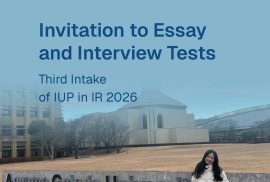
Invitation to Essay and Interview Tests – Third Intake of IUP in IR 2026

AnnouncementEvents Friday, 12 June 2026

The Department of International Relations, Faculty of Social and Political Sciences, Universitas Gadjah Mada, announces that the following applicants have passed their GMST and AcEPT in the Third Intake of 2026

SEARCH HERE

BERITA TERBARU

  • Invitation to Essay and Interview Tests – Third Intake of IUP in IR 2026
    12 June 2026
  • Invitation to Essay and Interview Tests – Second Intake of IUP in IR 2026
    8 May 2026
  • Invitation to Essay and Interview Tests – First Intake of IUP in IR 2026
    6 March 2026
  • Religion and Politics in South Asia
    4 August 2025
  • Transnationalism in World Politics
    4 August 2025

Kontak

  • hi@ugm.ac.id
  • +62 274 563362 ext. 210 (Sekretariat), 145 (IUP), 361 (Humas), 115 (IIS)
  • Hotline IUP: +62 813 2887 2042 (WhatsApp)
  • Hotline S-2: +62 823 2632 0009 (WhatsApp)

BB Fisipol Building, 5th Floor
Jl. Sosio Yustisia No. 1, Bulaksumur, Yogyakarta 55281, Indonesia

Situs Penting

Universitas Gadjah Mada

Ujian Mandiri

Admission Test UGM (International)

Fisipol UGM

Kantor Urusan Internasional UGM

Beasiswa UGM

Perpustakaan UGM

Facebook Instagram Linkedin X-twitter Youtube

Copyright © 2025 – Department  of International Relations